What Miniature Interiors Reveal About London’s Private Social Life
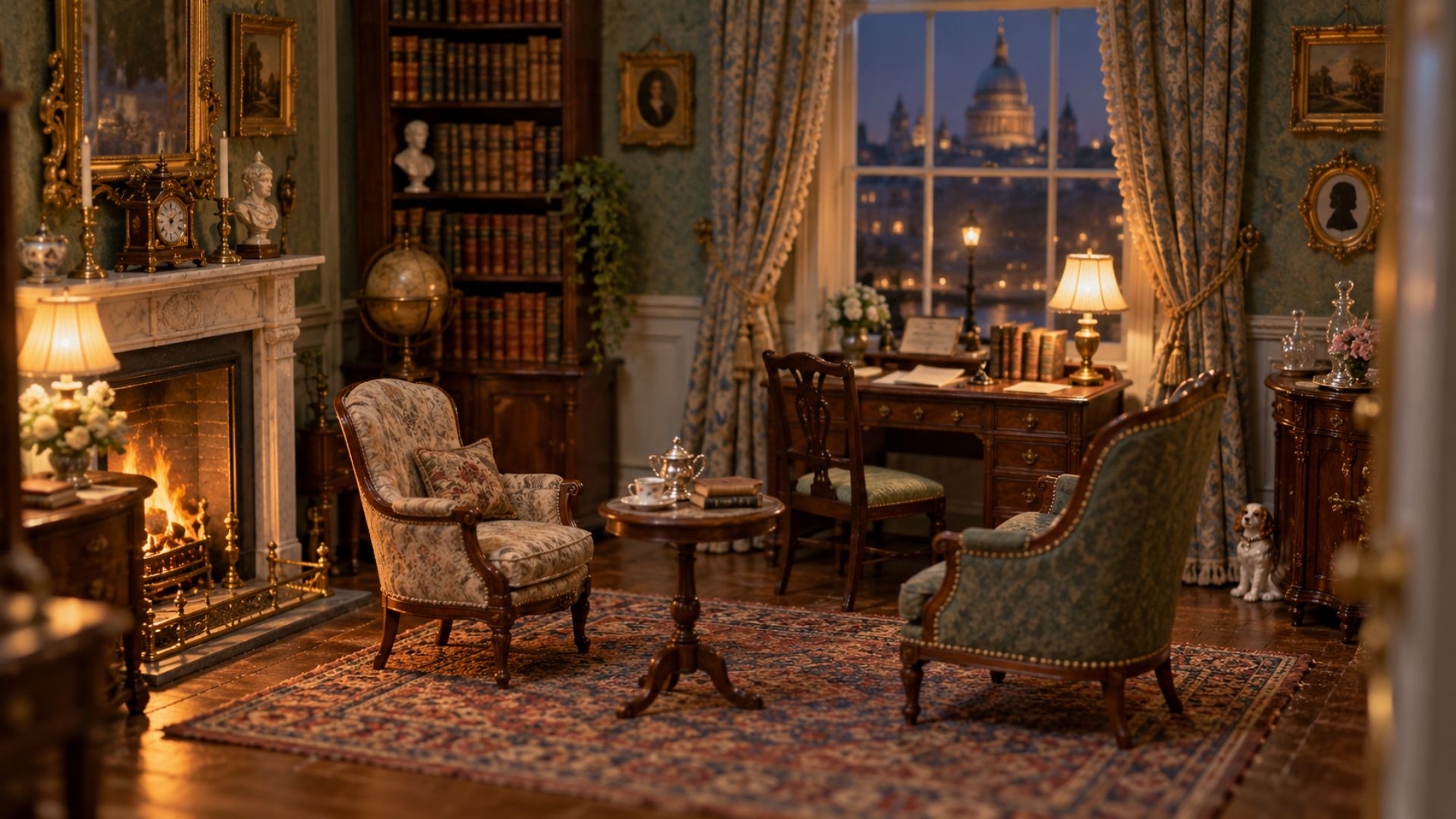
The smallest rooms can tell surprisingly large stories. A miniature parlour may contain no people at all, yet the placement of a chair, the angle of a writing desk and the objects displayed on a mantel can suggest who belongs there, how guests are received and which parts of life remain private. For makers and collectors, this is one reason miniature interiors hold attention long after their scale has stopped being novel. They are not simply reduced versions of full-sized rooms. They are carefully edited scenes of domestic and social life.
London offers especially rich material for this kind of work. Its interiors reflect centuries of changing architecture, trade, class, fashion and etiquette. A Georgian drawing room, a Victorian lodging house and a modern Soho flat may occupy the same city, but each communicates a different relationship between public appearance and private experience. Recreating these environments in miniature requires more than choosing period furniture. It requires understanding how rooms guided behaviour.
A Room Was Also a Set of Social Rules
Before open-plan living became common, rooms usually had clearer functions. The parlour or drawing room received visitors. Dining rooms formalised hospitality. Studies and libraries protected work, correspondence and private thought. Bedrooms sat farther from the public areas of the home. Even within modest houses, doors and corridors helped residents decide who could enter and how far.
Furniture reinforced those distinctions. Chairs arranged around a fire encouraged conversation, while a writing table facing away from the room suggested concentrated work. A screen could divide a shared space without rebuilding it. A small occasional table placed between two seats created a setting for tea, cards or a confidential exchange. These choices help a miniature scene feel inhabited even when it contains no figures.
The Victoria and Albert Museum is a useful authority for studying British furniture, decorative arts and domestic design. Its collections show how materials, construction and ornament changed over time. Makers can use museum objects as evidence rather than relying on the vague idea that anything dark, ornate or old-looking is “Victorian.” A miniature becomes more convincing when the wood, textile, hardware and proportions belong to the same visual world.
Privacy Had a Physical Shape
Privacy is often discussed as a personal preference, but interiors show that it also has a physical structure. Thick curtains blocked outside views. Folding screens created temporary boundaries. Lockable writing desks protected letters and account books. Servants’ passages allowed a household to operate while keeping domestic labour out of formal rooms. In crowded neighbourhoods, even a bed curtain or a chair placed beside a window could create a small zone of retreat.
That physical language still matters. Modern London homes may use different objects, but residents continue to manage visibility and access. Frosted glass, acoustic panels, discreet storage and carefully arranged seating all answer familiar questions: What should a visitor see? Where can a private conversation happen? How can people share space without surrendering every boundary?
The same concerns appear in modern social services built around privacy and trust. Readers interested in how discretion is communicated outside the domestic interior can consult, which discusses the role of reliability and private companionship in a contemporary London setting. The context is different, but the underlying need for clear expectations, respectful conduct and control over personal information is recognisable.
For a miniature artist, this provides a useful creative prompt. Instead of asking only what furniture belongs in a room, ask what the room is designed to protect. Is it preserving status, intimacy, routine or solitude? The answer can influence every detail.
Objects Reveal the People Who Are Missing
A successful miniature interior often works like a short story. The viewer arrives after something has happened or just before something begins. A cup left beside an open book suggests interruption. Two glasses on a tray imply a guest. A closed writing box hints at information that is not meant to be shared. An extra chair pulled toward the fire can indicate familiarity, while a stiff row of matching chairs feels formal.
These clues should be selective. Filling every surface with objects can make the room look like a catalogue rather than a lived environment. Begin with one human situation and choose details that support it. A private evening might need low lighting, two comfortable seats and a closed curtain. A social gathering might use brighter light, several conversation areas and evidence that refreshments have been prepared. A room associated with secrecy may benefit from a locked drawer, an unfinished letter or a screen placed slightly out of line.
Collectors can see how scale, finish and arrangement work together by studying the commissioned examples in the Rosemarie Torre photo gallery. The range of pieces also shows why accurate construction alone is not enough. Surface treatment, colour and the relationship between objects create the final sense of place. Those planning a scene can also review the available miniature furniture and kits before deciding whether a room needs a single focal piece or a coordinated group.
London Style Is More Than One Period
There is no single London interior. The city contains layers that overlap rather than replacing one another neatly. A room in a Georgian terrace may hold Victorian furniture, twentieth-century lighting and contemporary art. A converted warehouse may retain industrial brick while using modern upholstery. A hotel lounge may deliberately combine historical references to create a sense of continuity.
Miniature makers can use this mixture, but it should look intentional. Start by choosing the building’s approximate age and the identity of the imagined occupant. Then decide which objects were inherited, bought new, collected while travelling or kept for sentimental reasons. This produces a more believable room than selecting everything from one period label.
The approach also prevents a common mistake: confusing decoration with history. A floral pattern does not automatically make a room Victorian, and gilded furniture does not by itself make a setting aristocratic. Look at documented examples, note the practical use of each object and consider what its owner could realistically afford. Historical accuracy does not remove creativity. It gives creativity a firmer structure.
Scale Makes Social Distance Visible
In a full-sized room, people instinctively notice whether seats are close enough for conversation or far enough apart for formality. The same principle applies in miniature, where a few millimetres can change the emotional character of a scene. Chairs facing each other directly can feel intense. Seats turned slightly toward a shared fireplace feel companionable. A large table between two chairs creates distance, while a small table can suggest ease and familiarity.
Doorways matter too. A guest positioned near the entrance feels less established than someone seated deep inside the room. A clear path to the door can suggest caution or temporary presence. A screen or tall cabinet may hide part of the scene and encourage the viewer to imagine what lies beyond it.
Lighting strengthens these effects. A central overhead light exposes the entire room, while lamps and candles divide it into smaller areas. Pools of warm light can make a large room feel intimate. A dark corridor beyond an open door can introduce uncertainty without adding a single figure.
Building a Room Around a Human Question
The most memorable miniature rooms usually begin with a question about people. Who is expected? What has just been said? Which object carries emotional weight? What must remain unseen? Once that question is clear, decisions about furniture, colour and accessories become easier.
A London-inspired drawing room might explore the tension between formal hospitality and private conversation. A writer’s study could show the difference between a public reputation and a hidden life. A compact modern flat might examine how one room shifts from work space to social space at the end of the day. Each scene uses interior design to make relationships visible.
Miniatures reward this attention because they slow the viewer down. A full-sized room is experienced by moving through it, but a miniature is examined. The eye searches corners, shelves and half-open doors for evidence. When every detail supports the same human situation, the room becomes more than an attractive arrangement. It becomes a record of how people meet, withdraw, trust and protect their private lives.